Gameplay-
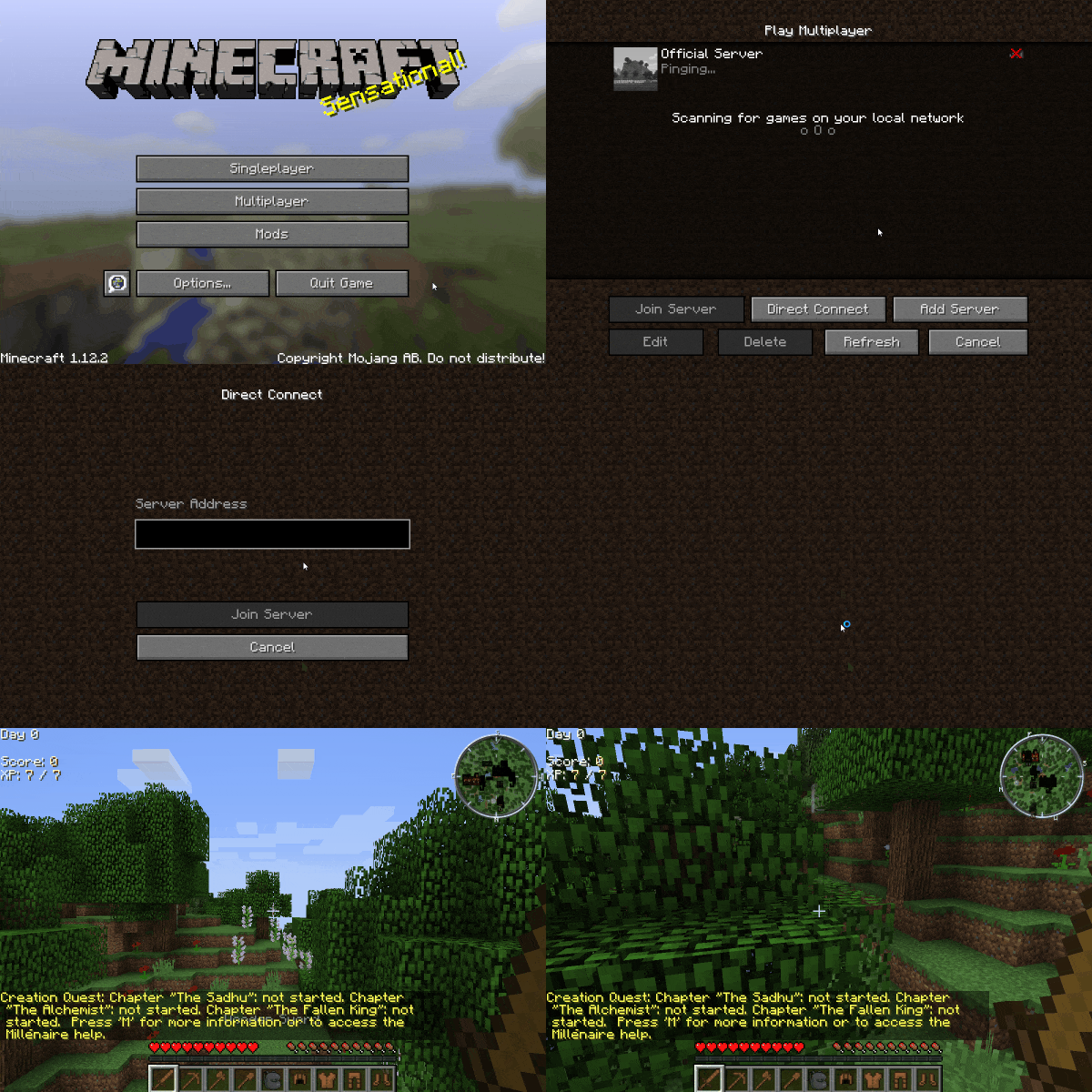
Minecraft is an open world game that has no specific goals for the player to accomplish, allowing players a large amount of freedom in choosing how to play the game. However, there is an achievement system. Gameplay by default is first person, but players have the option to play in third person mode. The core gameplay revolves around breaking and placing blocks. The game world is composed of rough 3D objects—mainly cubes— arranged in a fixed grid pattern and representing different materials, such as dirt, stone, various ores, water, and tree trunks. While players can move freely across the world, objects can only be placed at fixed locations on the grid. Players can gather these material blocks and place them elsewhere, thus allowing for various constructions.
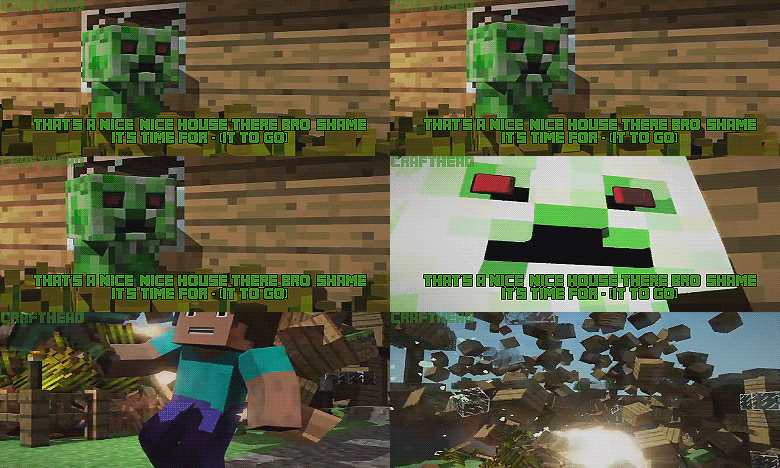
At the start of the game, the player is placed on the surface of a procedurally generated and virtually infinite game world. The world is divided into biomes ranging from deserts to jungles to snowfields. Players can walk across the terrain consisting of plains, mountains, forests, caves, and various water bodies. The in-game time system follows a day and night cycle, with one full cycle lasting 20 real-time minutes. Throughout the course of the game, players encounter variousnon-player characters known as mobs, including animals, villagers and hostile creatures. Non-hostile animals—such as cows, pigs, and chickens—spawn during the daytime. The player may hunt them for food and crafting materials. By contrast, hostile mobs—such as large spiders, skeletons, and zombies—spawn during nighttime or in dark places, such as caves. Some Minecraft-unique creatures have been noted by reviewers, such as the Creeper, an exploding creature that sneaks up on the player; and the Enderman, a creature with the ability to teleport and pick up blocks. The game world is procedurally generated as players explore it, using a seed which is obtained from the system clock at the time of world creation unless manually specified by the player. Although there are limits on movement up and down,Minecraft allows for an infinitely large game world to be generated on the horizontal plane, only running into technical problems when extremely distant locations are reached. The game achieves this by splitting the game world data into smaller sections called "chunks", which are only created or loaded into memory when players are nearby.
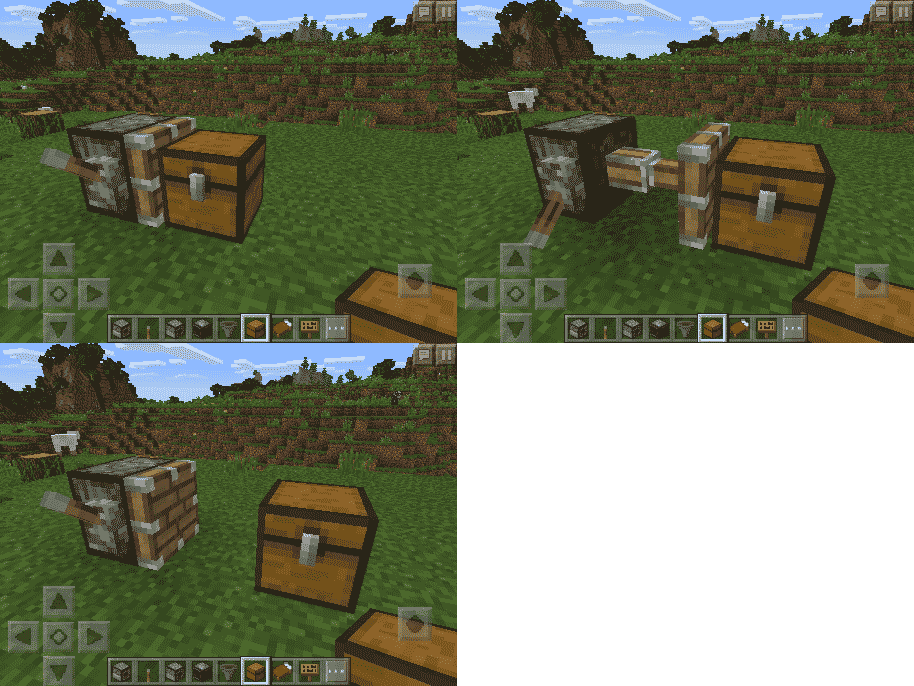
The game's physics system has often been described by commentators as unrealistic. Most solid blocks are not affected by gravity. Liquids flow from a source block, which can be removed by placing a solid block in its place, or by scooping it into a bucket. Complex systems can be built using primitive mechanical devices, electrical circuits, and logic gates built with an in-game material known as redstone.
Minecraft features two alternate dimensions besides the main world—the Nether and The End. The Nether is a hell-like dimension accessed via player-built portals that contains many unique resources and can be used to travel great distances in the over world. The End is a barren land in which a boss dragon called the Ender Dragon dwells. Killing the dragon cues the game's ending credits, written by Irish author Julian Gough. Players are then allowed to teleport back to their original spawn point in the overworld, and will receive "The End" achievement. There is also a second boss called "The Wither", which drops materials used to build a placeable beacon that can enhance certain abilities of all nearby players. Two mini-bosses, the Guardian and Elder Guardian, have been added in the 1.8 update of Minecraft.
The game primarily consists of three game modes: survival, creative and adventure. It also has a changeable difficulty system of four levels; the easiest difficulty (peaceful) removes any hostile creatures that spawn.
Survival Mode -
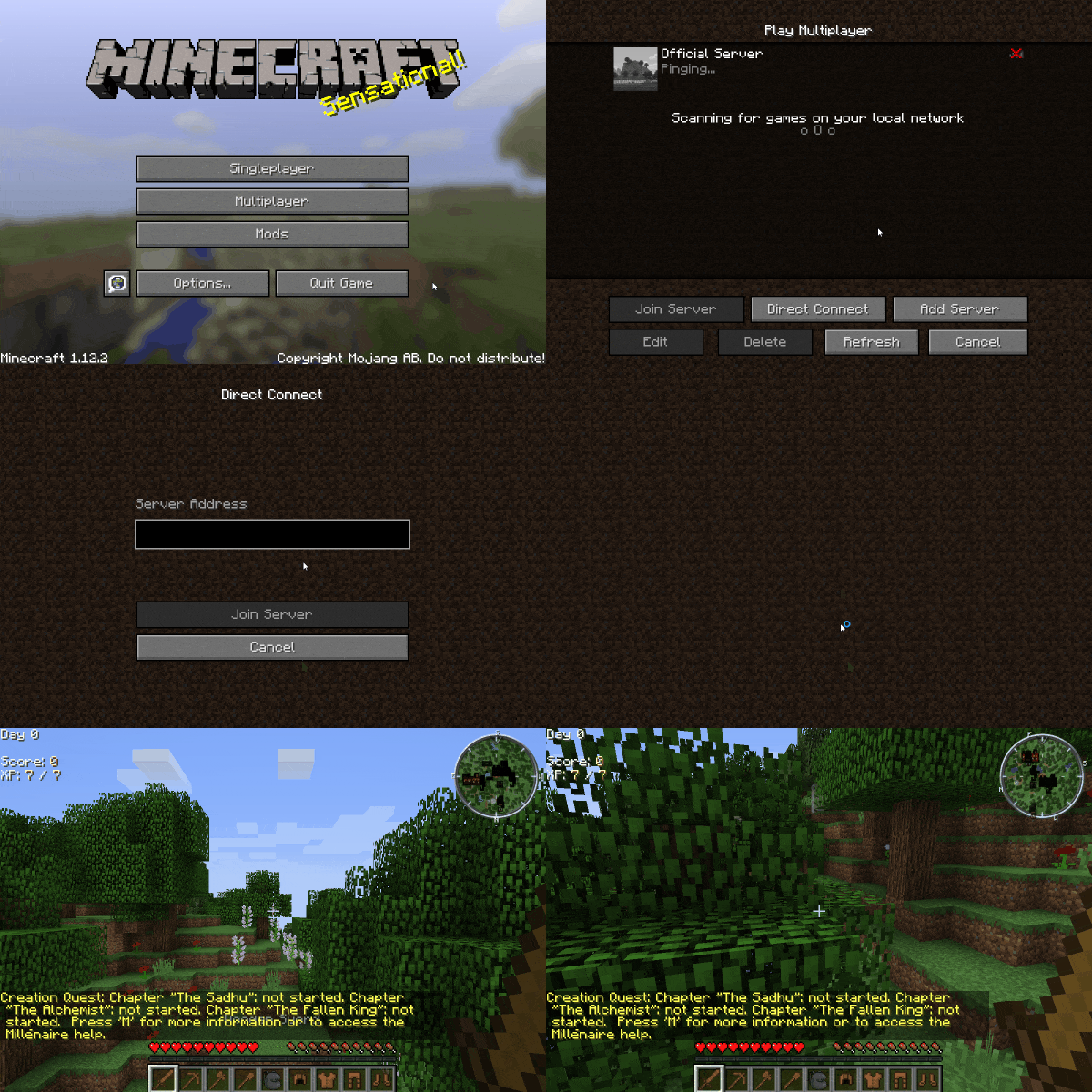
In this mode, players have to gather natural resources (such as wood and stone) found in the environment in order to craft certain blocks and items. Depending on the difficulty, monsters spawn in darker areas in a certain radius of the character, requiring the player to build a shelter at night. The mode also features a health bar which is depleted by attacks from monsters, falls, drowning, falling into lava, suffocation, starvation, and other events. Players also have a hunger bar, which must be periodically refilled by eating food in-game, except in "Peaceful" difficulty, in which the hunger bar does not drain. If the hunger bar is depleted, automatic healing will stop and eventually health will deplete. Health replenishes when players have a nearly full hunger bar, and also regenerates regardless of fullness if players play on the easiest difficulty.
There are a wide variety of items that players can craft in Minecraft. Players can craft armor, which can help mitigate damage from attacks, while weapons such as swords can be crafted to kill enemies and other animals more easily. Players may acquire resources to craft tools, such as weapons, armor, food, and other items. By acquiring better resources, players can craft more effective items. For example, tools such as axes, shovels, or pickaxes, can be used to chop down trees, dig soil, and mine ores, respectively; tools made of iron perform their tasks more quickly than tools made of stone or wood and can be used more heavily before they break. Players may also trade goods with villager mobs through a bartering system involving trading emeralds for different goods. Villagers often trade with emeralds, wheat or other materials.
The game has an inventory system, and players can carry a limited number of items. Upon dying, items in the players' inventories are dropped, and players re-spawn at the current spawn point, which is set by default where players begin the game, but can be reset if players sleep in a bed. Dropped items can be recovered if players can reach them before they despawn. Players may acquire experience points by killing mobs and other players, mining, smelting ores, breeding animals, and cooking food. Experience can then be spent on enchanting tools, armor and weapons. Enchanted items are generally more powerful, last longer, or have other special effects.
Players may also play in hardcore mode, this being a variant of survival mode that differs primarily in the game being locked to the hardest gameplay setting as well as featuring permadeath; upon players' death, their world is deleted.
Development -
The developer of Minecraft, Markus "Notch" Persson, began developing the game as an independent project while working for King.com and later jAlbum. He was inspired to create Minecraft by several other games such as Dwarf Fortress,Dungeon Keeper, and later Infiniminer. At the time, he had visualized an isometric 3D building game that would be a cross between his inspirations and had made some early prototypes. Infiniminer heavily influenced the style of gameplay, including the first-person aspect of the game, the "blocky" visual style and the block-building fundamentals. However, unlike Infiniminer, Persson wanted Minecraft to have RPG elements.
Minecraft was first released to the public on May 17, 2009, as a developmental release on TIGSource forums, later becoming known as the Classic version. Further milestones dubbed as Survival Test, Indev and Infdev were released between September 2009 and February 2010, although the game saw updates in-between. The first major update, dubbed alpha version, was released on June 28, 2010. Although Persson maintained a day job with Jalbum.net at first, he later quit in order to work on Minecraft full-time as sales of the alpha version of the game expanded. Persson continued to update the game with releases distributed to users automatically. These updates included features such as new items, new blocks, new mobs, survival mode, and changes to the game's behavior (e.g., how water flows).
To back the development of Minecraft, Persson set up a video game company, Mojang, with the money earned from the game. On December 11, 2010, Persson announced that Minecraft was entering its beta testing phase on December 20, 2010. He further stated that users who bought the game after this date would no longer be guaranteed to receive all future content free of charge as it "scared both the lawyers and the board." However, bug fixes and all updates leading up to and including the release would still be free. Over the course of the development, Mojang hired several new employees to work on the project.
Mojang moved the game out of beta and released the full version on November 18, 2011. The game has been continuously updated since the release, with changes ranging from new game content to new server hosts. On December 1, 2011, Jens "Jeb" Bergensten took full creative control over Minecraft, replacing Persson as lead developer. On February 28, 2012, Mojang announced that they had hired the developers of the popular server platform "CraftBukkit" to improve Minecraft 's support of server and client modifications. This acquisition also included Mojang apparently taking full ownership of the CraftBukkit modification, although the validity of this claim was questioned due to its status as anopen-source project with many contributors, licensed under the GNU General Public License and Lesser General Public License.

Popular Culture & Social Media-
Social media sites such as YouTube, Facebook, and Reddit played a significant role in popularizing Minecraft. Research conducted by the University of Pennsylvania's Annenberg School of Communication showed that one-third of Minecraftplayers learned about the game via Internet videos. In 2010, Minecraft-related videos began to gain popularity on YouTube, often made by commentators. The videos usually contain screen-capture footage of the game and voice-overs. Common coverage in the videos includes creations made by players, walkthroughs of various tasks, and parodies of works in popular culture. By May 2012, over 4 million Minecraft-related YouTube videos had been uploaded. Some popular commentators have received employment at Machinima, a gaming video company that owns a highly watched entertainment channel on YouTube. The Yogscast is a British organisation that regularly produces Minecraft videos; their YouTube channel has attained billions of views, and their panel at MineCon 2011 had the highest attendance. Other well known YouTube personnel include Jordan Maron, who has created many Minecraft parodies, including "Minecraft Style", a parody of the international hit single "Gangnam Style". Herobrine is a major community icon of Minecraft, who first appeared as a single image on 4chan's /v/ board. According to rumors, Herobrine appears in players' worlds and builds strange constructions. However, Mojang has confirmed that Herobrine has never existed in Minecraft, and there are no plans to add Herobrine.
Minecraft has been referenced by other video games, such as RuneScape, Torchlight II, Borderlands 2, Choplifter HD, Super Meat Boy, The Elder Scrolls V: Skyrim, The Binding of Isaac, Team Fortress 2, and FTL: Faster Than Light. It was also referenced by musician deadmau5 in his performances. A simulation of the game was featured in Lady Gaga's G.U.Y. music video, along with the command "/gamemode ARTPOP". After the release of Minecraft, some video games were released with various similarities with Minecraft, and some have been called "clones" of the game. There have been a few Minecraft-like and Minecraft-inspired games across various gaming platforms since the game became popular. Examples include Ace of Spades, CastleMiner, CraftWorld, FortressCraft, Terraria, and Total Miner. Additionally, in response to Microsoft's acquisition of Mojang and their Minecraft IP, various developers suddenly announced even further clone titles that are being developed specifically for Nintendo's consoles, as they are the only major platforms to not officially receive Minecraft, despite early rumours that the game was in development for the Wii U. These clone titles are either in development for Wii U, such as UCraft (Nexis Games), the Nintendo 3DS, such as Battleminer (Wobbly Tooth Games) and Cube Creator 3D (Big John Games), or for both Wii U and Nintendo 3DS, such as Stone Shire (Finger Gun Games). In an interview Kotaku had with Shigeru Miyamoto and Shinya Takahashi in regards to Minecraft coming to Nintendo's platforms, Miyamoto stated that the Wii U GamePad is a "good fit" for the title, and Nintendo could have popularised the game in Japan.
In 2012, Mojang received offers from Hollywood producers who want to produce Minecraft-related TV shows; however, Mojang stated that they would engage in such projects when "the right idea comes along." A documentary about the development of Mojang and Minecraft was released in December 2012. Titled Minecraft: The Story of Mojang, the film was produced by 2 Player Productions. The second episode of the seventeenth season of the animated television series South Park titled "Informative Murder Porn", features the boys distracting their parents from fighting each other withMinecraft. In the South Park episode, gruff character Corey Lanskin explained the Minecraft game by noting, "You punch the trees to get the wood, you get the wood to build a cabin. … Minecraft, it don't got no winner. It don't got no objective. You just fuckin' build an' shit. And seein' if other things can come and knock it down." On February 27, 2014, Notch revealed that Mojang is in talks with Warner Bros. regarding a Minecraft film to be produced by Roy Lee and Jill Messick. On October 8, 2014, Mojang COO Vu Bui stated that the movie was "in its early days of development", saying that it was a "large-budget" production, and also said that it might not be released until 2018. On October 16, 2014, the studio announced that it had hired Shawn Levy to direct the film.
Application -
The possible applications of Minecraft have been discussed extensively, especially in the fields of computer-aided designand education. In a panel at MineCon 2011, a Swedish developer discussed the possibility of using the game to redesign public buildings and parks, stating that rendering using Minecraft was much more user-friendly for the community, making it easier to envision the functionality of new buildings and parks. In 2012, a member of the Human Dynamics group at the MIT Media Lab, Cody Sumter, said that "Notch hasn't just built a game. He's tricked 40 million people into learning to use aCAD program." Various software has been developed to allow virtual designs to be printed using professional 3D printers or personal printers such as Maker Bot and RepRap.
In September 2012, Mojang began the Block By Block project in cooperation with UN Habitat to create real-world environments in Minecraft. The project allows young people who live in those environments to participate in designing the changes they would like to see. Using Minecraft, the community has helped reconstruct the areas of concern, and citizens are invited to enter the Minecraft servers and modify their own neighborhood. Carl Manneh, Mojang's managing director, called the game "the perfect tool to facilitate this process," adding that "the three-year partnership will support UN-Habitat's Sustainable Urban Development Network to upgrade 300 public spaces by 2016." Mojang signed Minecraft building community, FyreUK, to help render the environments into Minecraft. The first pilot project began in Kibera, one of Nairobi's informal settlements, and is in the planning phase. The Block By Block project is based on an earlier initiative started in October 2011, Mina Kvarter (My Block), which gave young people in Swedish communities a tool to visualize how they wanted to change their part of town. According to Manneh, the project was a helpful way to visualize urban planning ideas without necessarily having a training in architecture. The ideas presented by the citizens were a template for political decisions.
In April 2014 The Danish Geodata Agency generated all of Denmark in a scale of 1:1 in Minecraft based on their own free geodata. This is possible because Denmark is one of the most flat countries with the highest point at 171 meters where the limit in default Minecraft is about 192 meters above in-game sea level.
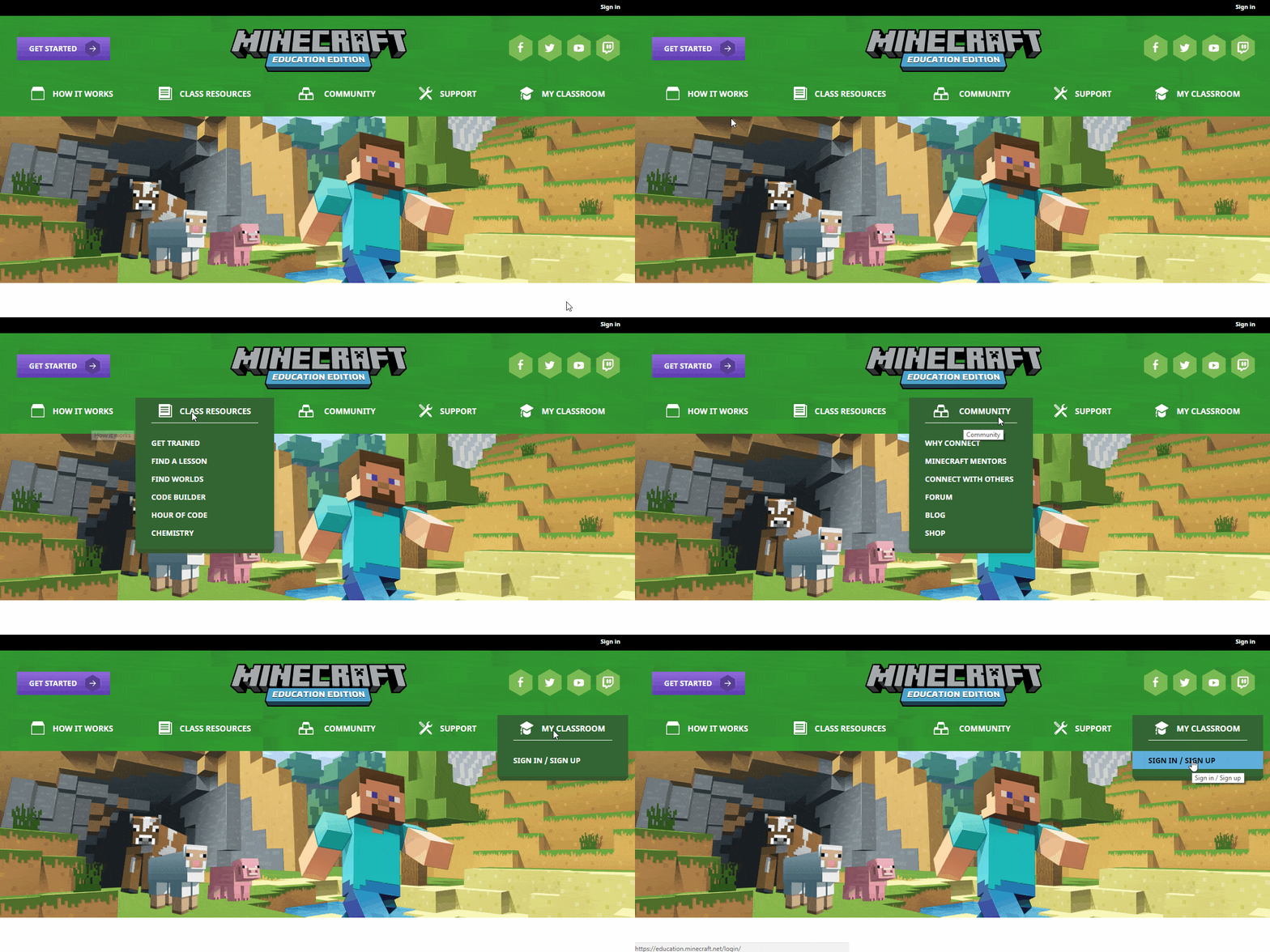
Minecraft has also been used in educational settings.In 2011, an educational organization named MinecraftEdu was formed with the goal of introducing Minecraft into schools. The group works with Mojang to make the game affordable and accessible to schools. In September 2012, MinecraftEdu said that approximately 250,000 students around the world have access to Minecraft through the company. A wide variety of educational activities involving the game have been developed to teach students various subjects, including history, language arts and science. For an example, one teacher built a world consisting of various historical landmarks for students to learn and explore.
In September 2014, the British Museum in London announced plans to recreate its building along with all exhibits inMinecraft in conjunction with members of the public.